

Summer Solstice: Light, Ritual, and the Turning of the Wheel
June 21, 2026
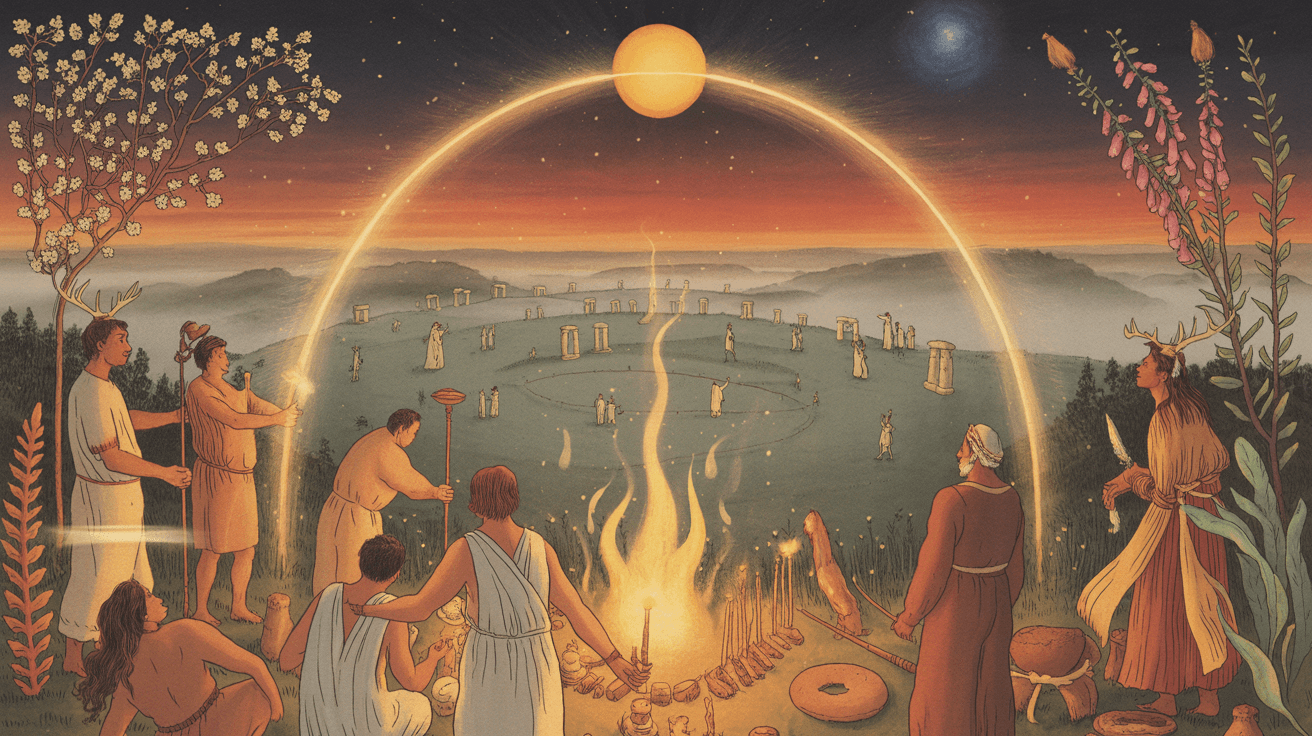
There's a specific moment, arriving in the small hours of Sunday morning, when the Earth's northern axis tips as far toward the Sun as it ever will this year. No fanfare. No pause in the music of the spheres. Just geometry — and yet, for at least five thousand years, humans have built monuments, lit fires, brewed potions, and danced barefoot through wet grass to mark it.
That's the fuhnke pocket: the place where the math is the magic and the magic is the math. So let's talk about the summer solstice — the mechanics, the lineage, and what you might actually do with it before the sun comes up tomorrow.
The Mechanics: A 23.44° Tilt and an Ancient Collision
The solstice isn't a day. It's an instant. Summer solstice 2026 arrives Sunday, June 21, at 4:24 AM ET — the longest day of the year in the Northern Hemisphere. In the UK, that's 9:24am BST, and globally it lands at 08:24 UTC.
Why now? Because Earth doesn't spin upright. The solstice is a direct consequence of Earth's axial tilt — the 23.44-degree angle between the planet's rotational axis and the perpendicular to its orbital plane, which astronomers call the obliquity of the ecliptic. At this exact moment, the Northern Hemisphere is leaning maximally sunward, the Sun traces its highest arc of the year, and solar energy strikes the ground at the steepest possible angle.
The deeper origin story is almost mythic in its own right. The tilt itself is believed to be a legacy of a collision early in Earth's formation, when a Mars-sized body — sometimes called Theia — struck the proto-Earth and knocked its rotation axis off vertical. The Moon is thought to have formed from the debris of that same collision. Both the Moon and Earth's axial tilt, in this view, are products of the same ancient impact.
Read that again. The reason you have a longest day, and the reason there's a moon hanging over your ritual fire, is the same primordial cataclysm. Every solstice is a 4.5-billion-year-old echo.
A few elegant footnotes for the engineering-minded:
- The solstice isn't the hottest day. The hottest weather typically occurs weeks after the summer solstice due to a phenomenon called seasonal lag. Land and water absorb and release heat slowly, so temperatures continue to rise even after the days start getting shorter. In most Northern Hemisphere locations, the hottest period falls in July or August, a month or more after the June Solstice. Thermal mass beats raw input. Always.
- The earliest sunrise already happened. Earth's 23.44-degree axial tilt reaches its northern peak, but the year's earliest sunrise already passed on June 14 due to the equation of time.
- The tilt itself wobbles. It has remained roughly 23.44 degrees throughout recorded history, though it slowly oscillates between 22.1 and 24.5 degrees over a cycle of approximately 41,000 years and is currently decreasing at about 47 arcseconds per century.
The Engineering: Stones That Catch the Light
Long before NASA, our ancestors were doing applied astronomy with rope, antler, and stone. Stonehenge was built to align with the sun on the solstices. On the summer solstice, the sun rises behind the Heel Stone in the north-east part of the horizon and its first rays shine into the heart of Stonehenge.
And it gets older. Just days before this year's solstice, archaeologists announced a stunning find: evidence for the earliest known alignment with the solstice in the Stonehenge landscape, showing that ancient people were using this feat of astronomical engineering to celebrate the solstice here at least 500 years before the alignment of the stones at Stonehenge. The prototype was wooden — post holes filled with chalk rubble to hold up thick wooden columns that may have been 12 to 14 feet tall. Upon further investigation, they also determined that a line drawn horizontally through the vertical timbers would have pointed to a spot on the horizon where the sun would have come up on the day of the summer solstice at that time.
Five thousand years ago, somebody stood on a hillside in Wiltshire and computed a sunrise. That is a spell. That is also a survey.
The Wheel Turns: Solstice Around the World
The instinct to mark this moment is nearly universal. A few of the rituals that have survived:
Britain & Litha
In Britain, thousands gather at Stonehenge for the midsummer solstice to watch the sunrise align perfectly with the Heel Stone. This tradition continues a lineage of ancient rituals honouring the Sun and seasonal change. Folk customs include bonfires and feasting, often blending pre-Christian and Christian elements around St. John's Eve.
Scandinavia & Midsommar
The Nordic countries arguably do it best. Perhaps the most well-known celebrations of Midsummer occur in the Scandinavian countries. In Sweden and Finland, Midsummer is one of the biggest holidays of the year, second only to Christmas. Families gather to raise the midsommarstång (maypole) and dance traditional ring dances. Meals featuring pickled herring, new potatoes, and fresh strawberries are enjoyed outdoors, accompanied by folk songs and schnapps toasts. The night is long and bright, with festivities often continuing until dawn.
The Andes & Inti Raymi
South of the equator, the wheel turns the other way. Inti Raymi originally began during the time of the Inca Empire, celebrated every June 21st, the winter solstice in the Southern Hemisphere, and the shortest day of the year. It was a sacred moment to honor Inti, the sun god, thank him for the harvest, and ask for blessings for the coming year. The festival was established by the Inca Emperor Pachacuti in 1430 BC and was later banned by Spanish colonizers. Inti Raymi was revived in the 20th century and is now one of the largest and most colorful festivals in South America.
Litha and the Modern Witch
Litha is the Pagan and Wiccan name for the summer solstice festival. It is one of eight Sabbats on the Wheel of the Year. Litha 2026 falls on Sunday, June 21, 2026. In Wiccan cosmology, the Oak King rules the waxing half of the year and reaches the absolute height of his power at Midsummer. However, Litha is also the moment he surrenders his crown to his twin, the Holly King, marking the beginning of the Sun's decline into winter.
The light peaks. Then it begins, infinitesimally, to recede. That tension — celebration and surrender — is the whole point.
What to Actually Do (Tonight, Tomorrow)
Practical magic, no preamble. Pick one or stack them.
1. Gather Your Herbs
This is the engineering bit witches have known for centuries: phytochemistry peaks with the photoperiod. St. John's Wort, lavender, mugwort, calendula, and chamomile are traditionally gathered at Midsummer. Their magical and healing properties are believed to be at their absolute peak when harvested exactly on the solstice. In Wales, this is also the traditional time for gathering wild herbs for medicine and magic, as most are fully grown by Midsummer and the power of this particular day will add to their benefits. For this reason, Litha is known as Gathering Day in Wales.
2. Brew Solar Water
The simplest spell in your kitchen: Place pure spring water in a clear glass container and set it in direct sunlight from early morning until noon on the solstice. You can surround the vessel with yellow flowers or Citrine. This potent, sun-infused water can be used to cleanse tools, bless your home, or brew Midsummer tea.
3. Build a Small Fire (or Light a Single Candle)
Ancient pagans celebrated the Solstice with torchlight processions and giant bonfires to ritually strengthen the Sun. Another tradition found among European cultures was centered on the need for balance between the Elements of Fire and Water—large wheels were set on fire and rolled downhill into creeks, rivers or lakes, perhaps as a charm against summertime drought. You don't need a hillside. A single beeswax candle, lit with intention at sunset, does the work.
4. Make a Solar Sachet
Bundle herbs of the sun — rosemary, chamomile, calendula and St. John's wort — and tie them up in a yellow or gold cloth. Keep it on your desk for the months ahead. Engineering talisman, perfume, and reminder all in one.
5. Sit With the Turning
Litha sits opposite Yule on the Wheel — the longest day staring across at the longest night. The sun is at the highest point of the year and from here, we begin to descend into the darker half of the year, the days gradually getting shorter once again. Honoring Litha helps us remember that everything is a cycle and change is inevitable. Life comes from death and the wheel still turns.
That's the ritual underneath every ritual. Mark the peak. Acknowledge the descent. Don't flinch.
Key Takeaways
- The 2026 solstice arrives at 08:24 UTC on Sunday, June 21 — a single instant of maximum northern tilt, not a 24-hour event.
- Earth's 23.44° axial tilt — born from the same primordial collision that formed the Moon — is the entire reason seasons exist.
- Solstice alignment is humanity's oldest surviving engineering project: Stonehenge and its newly-discovered wooden prototype prove ritual sky-tracking is at least 5,000 years old.
- Cultures globally mark this turning — Litha, Midsommar, Inti Raymi, St. John's Eve — with fire, herbs, dance, and feasting.
- Modern practice doesn't require a stone circle. Gather herbs at peak potency, brew solar water, light one candle with intention. The wheel turns whether you mark it or not — but marking it changes you.
References
- Summer Solstice 2026 Arrives Tonight: Longest Day, But Not Earliest Sunrise — TechTimes
- Summer Solstice — Royal Observatory Greenwich
- Summer Solstice 2026: Date, Time & Longest Day of the Year — AcadCalendar
- Equinoxes and Solstices 2026: Complete Guide — UniversalTimeDate
- Solstice at Stonehenge — English Heritage
- Discovery led by Phil Harding reveals 5,000-year-old 'prototype' for Stonehenge solar alignment — Wessex Archaeology
- Archaeologists Discover Evidence a Wooden Prototype for Stonehenge May Have Aligned With the Solstice — Smithsonian Magazine
- What is the Summer Solstice? Rituals and Reflection — Centre of Excellence
- Midsummer Day: Celebrating the Height of Summer and Ancient Traditions — Jen Sequel
- Inti Raymi 2026 in Cusco: What to Know About the Festival of the Sun — TreXperience
- Inti Raymi: Ancient Incan Sun Festival Explained — Machu Picchu Org
- Litha & Midsummer: The Complete 2026 Guide for Witches & Pagans — Moonlight Mysteries
- Litha (Summer Solstice) – The Wiccan Calendar — Wicca Living
- Green Witch Sabbats: The Plants and Herbs of Litha — Green Witch Living
- How to Celebrate Litha: A Wiccan Ritual — The Not So Innocents Abroad